

Picks and Shovels in the AI Gold Rush
The cloud era created multiple $10bn+ middleware companies who sold 'picks and shovels' to other plays in the ecosystem. We see parallels with the AI market today and believe a similar story will play out with a new generation of tools.


In the California gold-rush, the largest fortunes went not to the prospectors panning for gold, but to the traders who supplied the inputs – picks, shovels, rail roads, banking. The same logic holds true in technology cycles, rewarding vendors who supply foundational tools and services which every market participant must buy regardless of whichever platform wins mainstream adoption. In high volatility markets where it is hard to understand where steady-state value will accrue, investing in ‘picks and shovels’ provides exposure to the macro (theme) with lower risk to the micro (use case). With the AI market in a state of constant flux, we at Defiant have a preference to back such tools - the essential infrastructure, data plumbing and developer operations that every AI product needs, regardless of use-case or hype cycle.
How it played out in the cloud-computing boom
Cloud adoption exploded from 2006 to present day, going from literally nothing to over 70% of enterprise workloads. Over this 20-year period, a plethora of SaaS applications came and went, while a large amount of value accrued to the ‘picks and shovels’ who were able to abstract complexity away from the builders. We think of cloud middleware (ala the Picks & Shovels) as comprising 6 areas (with overlap in many cases), each having witnessed significant value accrual and leading to multiple companies of decacorn scale.
| Cloud era ‘Shovel’ | Overview | Reference companies |
|---|---|---|
| Data Platforms | Central repository for structured and unstructured data in variety of formats. Historically dominated by Relational DBs and Document Key/Value DBs. |
Snowflake ($70bn+ market cap) MongoDB ($20bn+ market cap) |
| Observability | Revolves around health, debugging and performance optimisation of the broader cloud system. |
Datadog ($50bn+ market cap) |
| Security | Measures to protect data, applications and infrastructure within the cloud environment. |
Cloudflare ($70bn+ market cap) Wiz ($32bn acquisition by Google) |
| Identity & Access | Systems that manage authentication (who you are) and authorization (what you can do). |
Okta ($15bn+ market cap) Auth0 ($6.5bn acquisition by Okta) |
| Data Orchestration | The pipes, automations and transformations which connect data across the stack and make it useful. |
Databricks ($60bn+ private valuation) |
| DevOps | Developer tools related to code deployment. Testing, containerisation, collaboration and code writing. |
GitHub ($88bn+ acquisition by MSFT) GitLab ($8bn+ market cap) |
| Service APIs | Point solutions providing embedded third-party functionality e.g. Payments, Communications etc. |
Stripe ($90bn+ private valuation) Twilio ($20bn+ market cap) |
What changes in the AI era?
Everything and nothing.
The cloud tech stack isn’t going anywhere. It will continue to be the foundation of modern software applications, however it is evolving to handle the ever-growing needs of LLMs. We believe every modern software application will rely on LLMs to some degree. Existing software applications are embedding AI capabilities into their feature sets, while a whole new breed of AI-native applications are being built from the ground up to maximally utilise AI.
This evolution is taking part across all three layers:
1. Foundational models as key infrastructure:
LLMs have become a key infrastructure component for any piece of software. Foundational models will be present in every application and it is likely specialised models (either vertical specific of proprietary to the company) will also claim a spot within the future AI tech stack. These models are becoming increasingly interlinked with the data warehouse, seeking to gain additional context and drive superior performance and utility as a result.
2. The emergence of LLMOps and Agentic Orchestration tooling as a category:
Due to their probabilistic nature, LLMs need to be nurtured. They are not ‘set and forget’. To ensure LLMs drive reliable and repeatable results a whole new set of LLMOps tools will emerge. Everything from evals and traces, observability to governance and prompt + model management.
Agentic systems are the new frontier for growth. Adoption so far has been concentrated around low-touch use cases (SMB and Mid-market) due to lower integration complexity; however we think it’s a matter of time before agents disrupt the enterprise. A new class of ‘Agent Builders’ has already emerged to help mainly non-technical users implement these systems (e.g. Crew.ai), but we think the final destination is more akin to ‘agentic orchestration’ – tooling which focuses on unlocking agent capabilities by providing them context, 3rd party API integrations, payment rails, user-engagement loops and more.
3. The creation of AI native applications
We are seeing a new generation of applications emerge which are being built with embedded AI capabilities from day 1, as opposed to retrofitting AI to existing software. The workflows, pipes and rails for these applications are different from the cloud-era, giving competitive advantages around features development, product velocity and team scaling. AI native applications are outcompeting legacy software and we expect many more category defining companies to emerge.
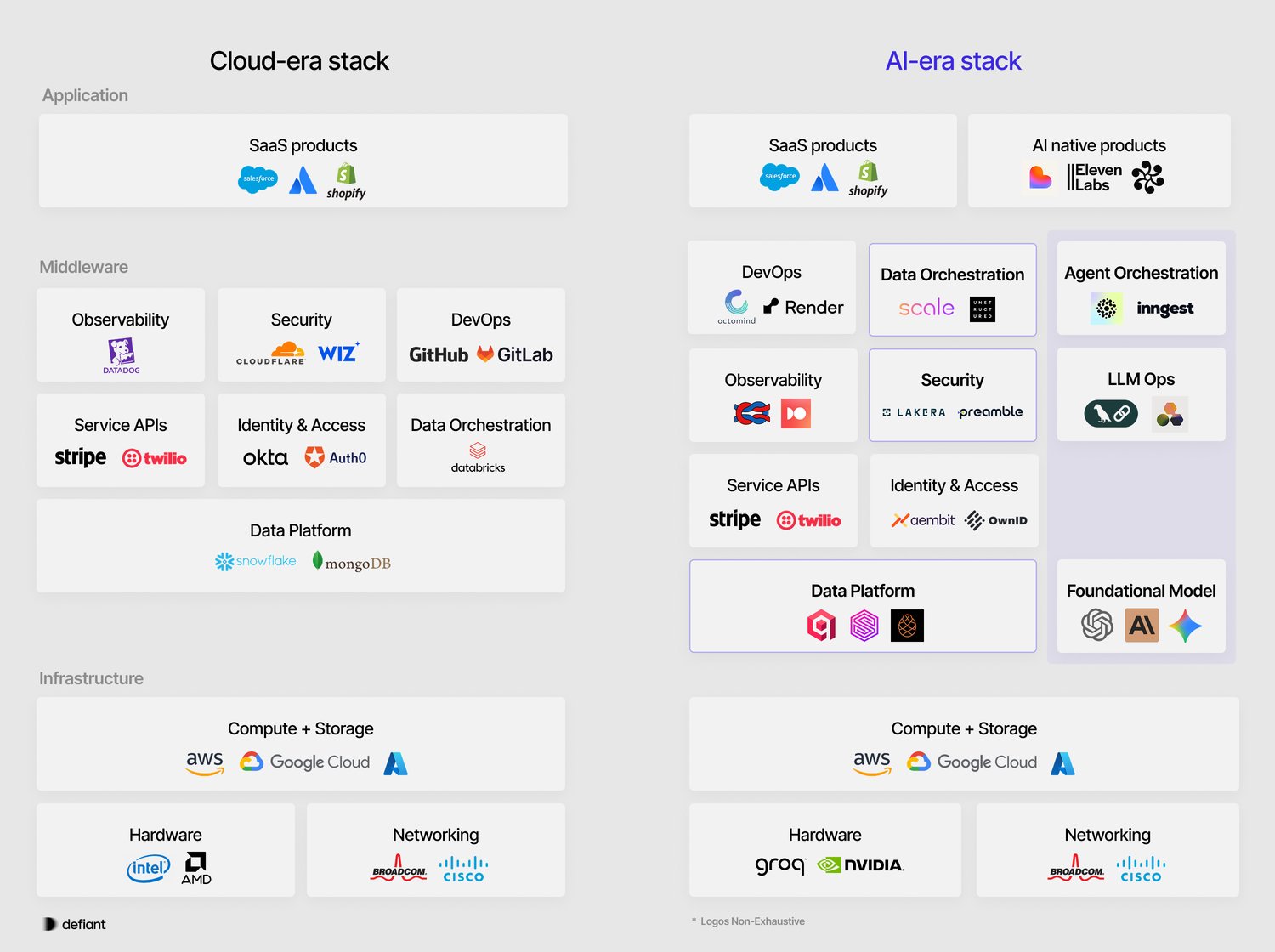
Cloud vs. AI era tech stack
We've created the below graphic to show how we see the new AI tech stack compared to the previous generation.
Where we see opportunity
Looking into the new AI tech stack we ask ourselves where the investment opportunities lie. Undoubtedly many new AI-native applications will be built and scaled to huge success, and we hope to invest in several of these companies at Defiant. Infrastructure is one area we will be side-stepping due to a feeling the foundational model bets have already played out, and any new models will likely be incredibly capex intensive and as such not well-suited investments for an early-stage fund such as ourselves.
Unsurprisingly, middleware is what has our attention. Specifically, the buckets where we believe the cloud era incumbents won’t necessarily win. It would be foolish to think the likes of Datadog and Snowflake are going to let this AI opportunity get away from them, and many of the incumbents have already come out with AI era features to capture the growing opportunity.
| AI era ‘Shovel’ | Hypothesis | Value accrual to | New era reference companies* |
|---|---|---|---|
| Data Platform | Value will likely be captured by cloud era incumbents (e.g. Snowflake) who have already built features to accommodate the demands of AI workflows. There is room for new AI-first databases to take market share if they can offer superior performance around specific use case (e.g. Vector or Graph). | Incumbents mainly | Pinecone, Qdrant, SurrealDB, CedarDB |
| Observability | Value will likely be captured by cloud era incumbents (e.g. Datadog) although we see potential for best in class AI solutions to scale. The difference between ‘cloud’ and ‘AI’ observability is not a huge technical leap and the incumbents already have well performing products and distribution moats which will be hard to displace. | Incumbents mainly | Langfuse, Helicone, Dash0, SYNQ, Pydantic, Middleware, |
| Security | Security is always a technical field requiring the ability to deal with high volume and edge case challenges. LLMs introduce new threat vectors which have not been solved by existing solutions. | New era | Lakera.ai, Preamble, |
| Identity & Access | Agentic AI introduces new I&A considerations; however, we believe that the majority of the category will remain people based and thus be captured by incumbents. | Incumbents | OwnID, Aembit, |
| Data Orchestration | New tools are needed to transform structured and unstructured data (in various file formats) into model-ready chunks and representations (e.g., Markdown, embeddings). With exponential growth in data generation, orchestration will be increasingly more important. | New era | Scale AI, Unstructured.io, |
| DevOps | Notably separate from LLMOps and related to code deployment for which the core use case and tooling remains the same as the cloud era. Incumbents have a moat and we believe they will persist. | Incumbents | Render, Octomind, TensorStax, Momentic, |
| LLM Ops | This is an entirely new vertical dealing with AI specific problems. Evals, prompt management, hallucinations, costing etc. are crucial to LLM performance, and LLMOps as a result will become a large category. | New era | Langchain, Weights and Biases, AdaptiveML, .txt, Opper |
| Agent Orchestration | This is an entirely new vertical dealing with AI specific problems. Agents will become a large part of the economy and correctly implementing and orchestrating their operations will be mission critical. | New era | Crew AI, Mem0, Inngest, Relevance AI, Cognee Daytona |
Learnings from the cloud era
History doesn’t repeat, it rhymes, and we think several trends will play out in the AI era as they did during the cloud.
1. Point solutions becoming platforms
Many of the category defining cloud companies started out as point solutions before expanding into platforms. Datadog’s first product was IT monitoring, Snowflake’s was a Cloud Warehouse, Stripe’s an online payment API. A strong first act allowed these companies to layer multiple products and become platforms. We think the same arc will play out with AI middleware.
2. TAM is a lagging indicator
Tied to the above, as an investor it is easy to be dismissive of TAMs by sticking to skeuomorphic thoughts and not seeing market expansion opportunities. Many investors overlooked the cloud-era middleware due to concerns the ACVs weren’t large enough nor the customer pool to create multi-billion dollar businesses. They failed to account for a rapidly expanding market (cloud adoption led to more tooling requirements, more data, more problems, and overall huge TAM growth).
3. Lower friction wins
LLMs have been a poster child for quick customer value. There has arguably never been a product which delivers more instant value than ChatGPT to a non-technical user. The most successful cloud companies were able to deliver rapid value to users (e.g. Stripe’s 7 lines of code) and AI tooling which can emulate this (via embeddings, integrations, context, pre-built connectors etc) will similarly outpace their competitors.
4. Pricing and utilisation go hand in hand
Software used to be sold in annual contracts, paid upfront. The cloud shifted this to a subscription ‘SaaS’ model, aligning utilisation with monetisation. AI pricing is similarly evolving to focus on usage based pricing, often tied to API calls or token-cost + models. We think this shift leads to greater transparency, happier customers, and often higher overall spend when the models deliver on their promises.
Looking ahead
The lesson from the cloud era is clear: durable value accrues to the infrastructure that every builder depends on, not to the individual applications that sit atop. In AI, our analysis suggests the same pattern will repeat - but with a middleware stack that looks different from the past.
Several categories, like data platforms, will see incumbents extend their lead. Others, like LLMOps and agent orchestration, are still open territory where new entrants can define the standard. These categories are less sensitive to swings in model performance, integrate deeply into customer workflows, and compound value as usage grows. They are also where incumbents face genuine gaps and where defensibility can come from data, integration depth, and iteration speed (as we spoke about here).
Just as AWS and Snowflake became unavoidable in the cloud era, we expect a new set of “AI-era picks and shovels” to emerge from these open categories. Defiant’s focus is to identify and back those companies early - before the winners are obvious, while the rails of this new platform are still being laid.
